
A MAD Guide for the Perplexed: Caviar
Questions to consider before your next bump
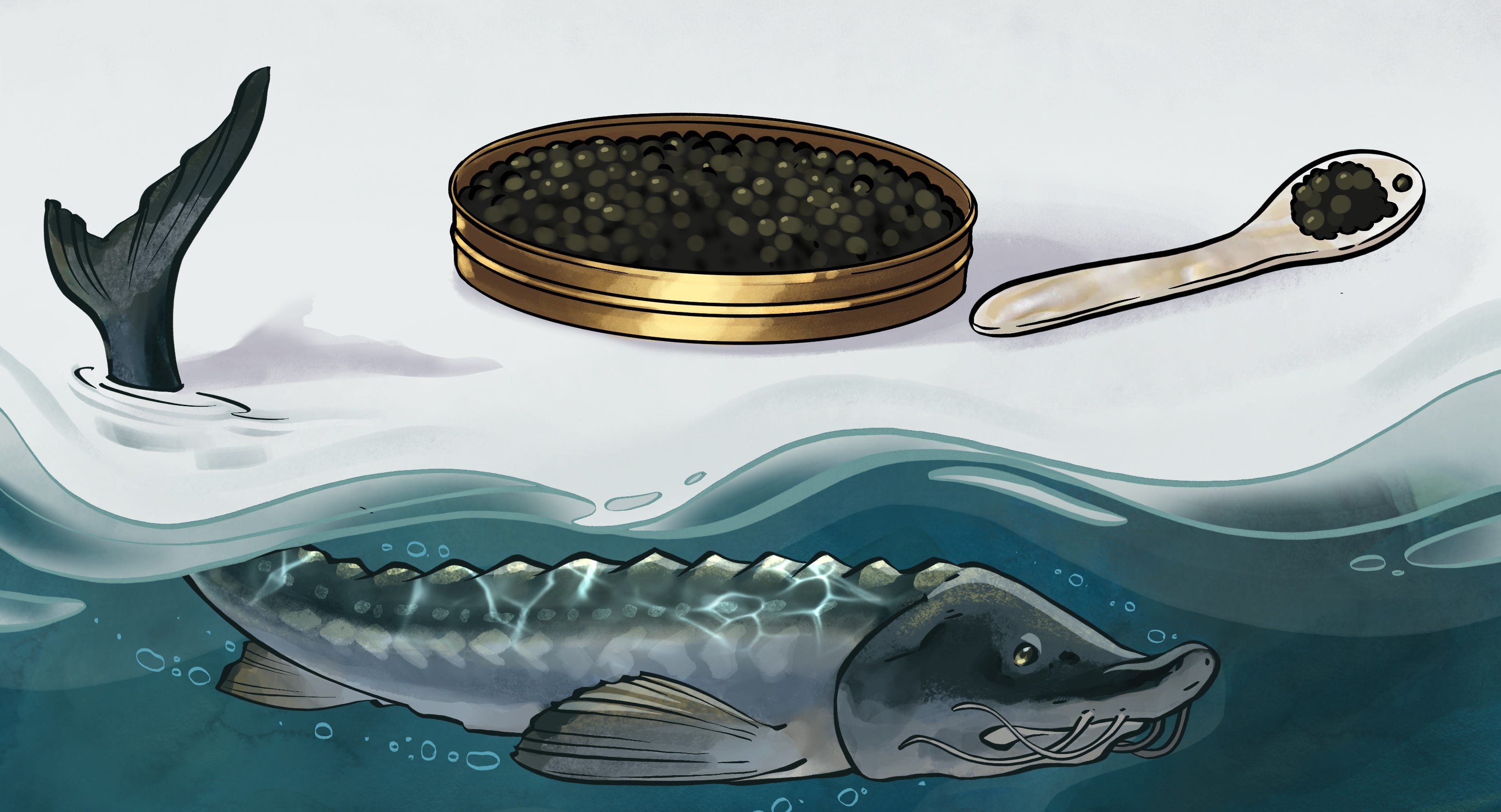
Avocados. Bluefin. Chocolate. Salmon. It’s a complicated jungle out there for anyone trying to navigate the sustainability of a number of ingredients. So we’ve started an ongoing series intended to help chefs and restaurateurs cut through the thicket of competing claims, confusing information, and plain old bullshit surrounding some foods. In each issue, we explore some of the key questions and issues and give some pointers on what to look for, and talk to chefs about how and why they’ve made the decisions they have. For this edition, we’re focusing on everyone’s favorite luxury-ingredient-turned-occasional-pizza-topping: caviar.

As the pandemic was winding down, a curious trend took hold. Diners, newly released from lockdown, were in the mood to splurge. Restaurants, decimated by the forced closures, needed to boost their checks. The two sides seemingly arrived at the same conclusion: Caviar on everything.
Restaurants started spooning it not only onto pretty much everything. The luxury ingredient still costs a ton–between 200 to 750 euros per 100 grams for beluga or ossetra. But now, it started showing up on schnitzel, on pizza and pasta, on fried chicken, on ice cream, on the rim of cans of Miller Lite. And, of course, heaped like a pile of lumpy dirty cocaine onto the manicured hands of innumerable food influencers.
The trend hasn’t shown signs of stopping. And with caviar once again showing up on those year-end lists lamenting the over-exposed and predicting the next months’ fads, we thought it a good time to look into how and if caviar can be sourced responsibly.
It may not surprise you to learn that it’s complicated. To understand why, we need to start with a little sturgeon biology lesson.
When people refer to sturgeon as the dinosaurs of the fish world, they’re not kidding: sturgeon have literally been around since brontosauruses roamed the earth. And if the species itself has had a long life on this planet, so too do the individuals that comprise it. Sturgeon in the wild live 50 to 100 years– kinda the same as humans, in other words.
Sturgeon don’t just live long; they also reach maturity later than most other fish. It varies by sturgeon species, but in most cases, their sex can’t even be determined until they are around 4 years old. If they happen to be on a farm when that discovery is made–usually via ultrasound–well, let’s just say it’s not a happy day for the boy sturgeons. Unless they win the aquaculture lottery and are chosen as brood stock, males are slaughtered soon after sexing.
Apparently, it’s not worth keeping the freeloaders around, just so they can eat up all the groceries and play video games in their parents’ basement.
Females, on the other hand, get long-term care, since they won’t lay their first set of eggs until they’re somewhere between 7 and 20 years old (although wild beluga, the late bloomers of the sturgeon family, wait until they’re roughly 35). If they’re left alive after that (not a given; see below) they won’t reproduce again for another two to nine years.
All of this helps explain what makes caviar so expensive. But as we’ll see, it also helps explain why the sustainability and animal welfare issues around them are so tricky.
Farmed, not wild
Through overfishing and habitat destruction, sturgeon populations were already seriously declining through much of the 20th century. But when the Soviet Union, the largest producer at the time, collapsed in 1990, the regulations that the government had tightly maintained for protecting the species as it swam up the Volga river to spawn in the Caspian Sea collapsed with it. Poaching exploded, and within a decade, sturgeon populations were in danger of total extinction.
To keep that from happening, an international agreement called CITES was applied to all 26 species of sturgeon, making the trade in wild sturgeon flesh or eggs illegal. In the wake of that, sturgeon farming took off, and today, there are farms in Europe, the Americas, Asia (China is, no surprise, the largest producer), and even the island of Madagascar.
Today most caviar–a full 380 tons of it each year– is farmed. But that hasn’t entirely brought an end to the wild stuff. There is a lot of money to be made in sturgeon eggs, which means there are a lot of criminals poaching them. In fact, tests carried out by the World Wildlife Foundation in 2021 found that nearly 20% of caviar from the lower Danube and Black Sea was actually wild caught. Making it worse, the CITES labeling system, which was designed to insure that caviar was both legal and traceable, isn’t being correctly enforced. According to the WWF’s caviar trade expert, Jutta Jahrl, there is a problem with both “aquaculture caviar “falsely sold as wild, but also wild caviar ‘laundered’ as farmed to legalize it.”
So, here as with cows, salmon, and carrots, we return to the golden rule of good sourcing: know your farmer.
But…aquaculture?
Yeah, we know. As we’ve written before, aquaculture can come with its own set of problems. One of the key ones facing salmon farmers, who raise their fish in open-net sea pens, isn’t really an issue here: most farmed sturgeon are raised either in land-based tanks or in ponds or lakes where there isn’t the same risk of them escaping and breeding with wild fish.
But there are other issues. Feed is a key one: In the wild, sturgeon are bottom-feeders that eat invertebrates and sometimes smaller fish. On farms, they are generally fed feed based on fish meal made from less desirable fish or fish parts. “Farming sturgeon is still an inefficient use of resources, as it relies on a high intake of fish meal and oil per gram of protein produced,” Hannah Macey from the Sustainable Restaurant Association says. “This comes with its own sustainability problems.”
A lot of fish feed is industrially produced, includes ingredients that sturgeon do not naturally eat, like soy or wheat, and is shipped from far away. More responsible farms often make their own feed–a good sign that they are serious about ensuring their fish get proper nutrition and reducing their carbon footprint.
Water pollution from fish poo and uneaten feed can also be a problem for sturgeon farming, and an especially acute one because contamination can damage the texture and flavor of the prized roe. That’s why closed systems that use a technology called Recirculating Aquaculture System that filters waste (but not valuable nutrients or minerals) from the water before it’s recirculated into the tanks are considered the gold standard.
There’s a trade-off, of course. In the wild, sturgeon are born in rivers. They migrate to the sea to grow up, and then they return to the river of their birth when it’s time for them to spawn. Closed system farms manipulate the cycle. “By controlling the water temperature you can push the sturgeon to mature at a younger age,” says Jacob Marsing-Rossini, the founder of Rossini Caviar. “Or you can let them swim outdoors, using only the sun to heat the ponds.” The latter, he adds, more closely mimics sturgeon’s natural behaviors–and, he says, produces the best quality caviar.
To Kill or Not To Kill?
Once a female sturgeon is heavy with eggs (and here the operative word is ‘heavy’; the average fish produces between 5 and 20 kilos at a go, with superachievers cranking out up to 100 kilos), the farmer needs to figure out how to extract the eggs at the optimal moment while doing least damage to the roe.
For a long time, damage to the fish wasn’t really a part of the equation: the traditional method is just to kill it (most commonly via a blow to the head or bolt gun) and pull out the eggs. But in recent decades, another approach has emerged and positioned itself as more ethical.
Some farms have employed what is basically a sturgeon caesarian, cutting an incision in the belly–sometimes large enough that it requires stitches after the eggs are extracted. But the method that most frequently gets heralded as ‘ethical’ is so-called milking. Invented by German marine scientist Angela Köhler, the fish’s belly is massaged in a way that it releases the eggs. The fish stays alive and can theoretically go on to produce more roe.
Not everyone is convinced that ‘milking’ fish is actually kinder. To get them to release their eggs, the sturgeon are injected with hormones, and the handling itself induces stress. “From a welfare perspective, we just don’t know whether no kill is better, because the ways that they extract the eggs can be quite harmful,” says Wasseem Emam, director of the Ethical Seafood Research organization. “You can see lethargy in the fish afterwards, or changes in their eating behavior.”
And stress, as we all know, can be its own killer. “Does it make much sense?,” asks Marsling-Rossini, whose caviar is produced using traditional slaughter methods. “Because you can milk it, fine, but is the story worth anything, if the sturgeon is killed four or five months later?
But while we’re on the subject of animal welfare, here’s one other thing to ask about: purging. Because the flavor of high-quality caviar is delicate, and what the fish eats can interfere with it, it’s common for producers to stop feeding their fish before they slaughter. In many cases these fasts are a matter of a few days to a week or so. But some producers intent on “purity” extend them for as long as two months, or longer.
Some Alternatives?
In sum: there’s a lot of uncertainty and opacity around caviar. Sourcing it responsibly means getting to know your supplier, and maybe even visiting their farms. It definitely means asking a lot of detailed questions: Where are the fish raised? What are they fed? How is their water cleaned and heated? At what age do they produce eggs, and how are those eggs extracted?
Once you know the answers, you might decide to source it only from small farms that meet your standards for responsibility.
Or, you might decide to start looking at options, either with other kinds of fish roe, alternative versions made from algae, or even the recently developed cultivated version.
Or, you might decide that the many years and amazing biology that goes into producing it deserves a more considered treatment than being sucked off a chicken nugget.
Or, you might take a page from chef Ángel León and opt out all together. Although his restaurant Aponiente in southern Spain is devoted entirely to seafood, it doesn’t serve caviar. “It doesn’t really make sense in my kitchen,” Ángel says. “It’s become a kind of global topping, like mayonnaise. Or ketchup.”

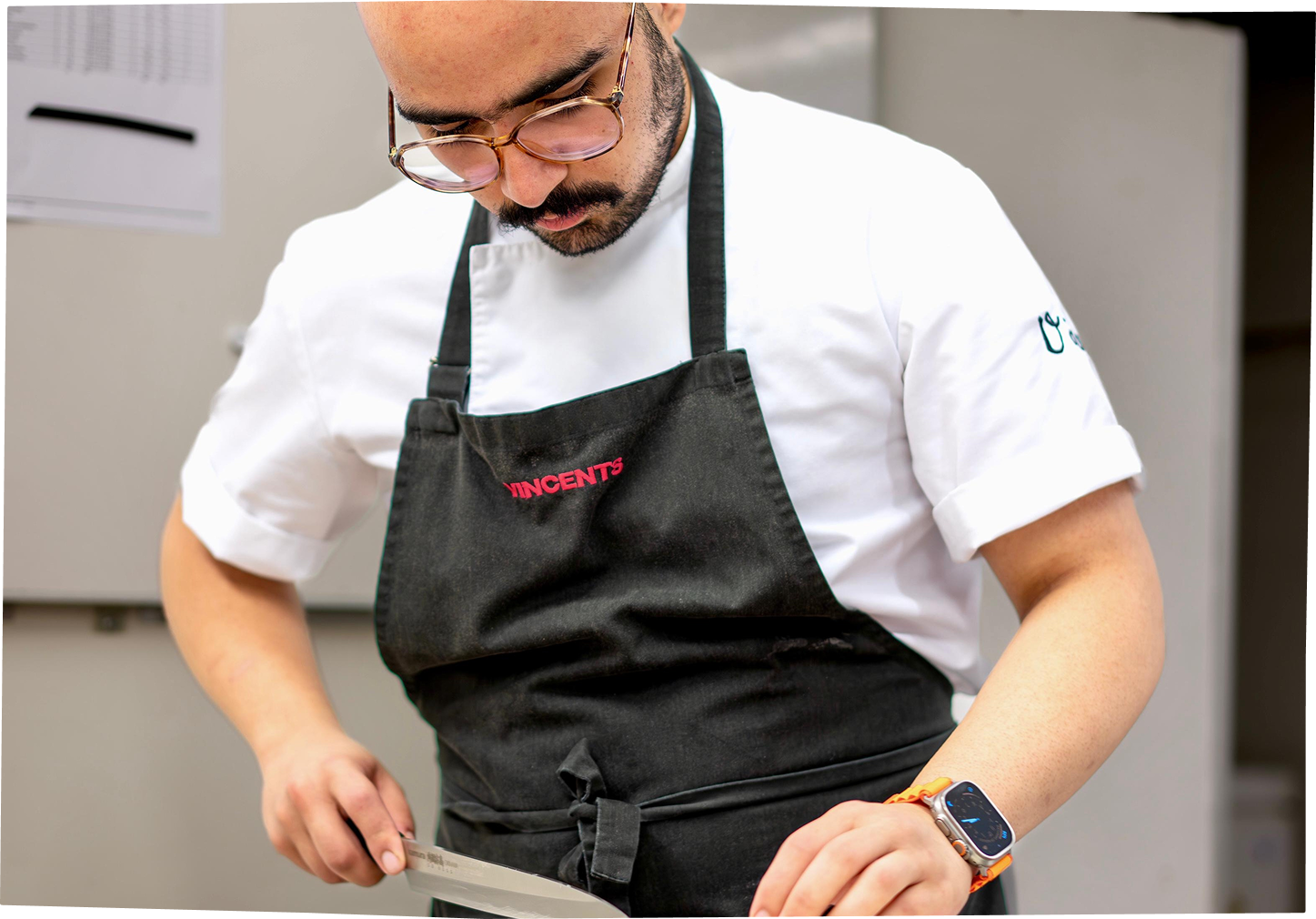
Starting from Zero-Zero | Eilia Attar
When you ask most people why they became chefs, they will tell you it has to do with love: a love for food, or for the people who cooked for them when they were small, or for the way that food itself expresses love. But what if love isn’t enough?
I was born in Iran in 2000, into a world where food, family, and tradition were at the heart of daily life. My earliest memories were filled with the smell of my mother’s cooking. She was, and still is, an excellent cook, the kind of woman who can create magic with the simplest ingredients. Ghormeh Sabzi was always there, slow-cooked and deeply comforting, with parsley, fenugreek and dried limes. As a child, I didn’t know what “fine dining” meant, but I knew what it meant to love food. I loved sitting at the table, tasting, smelling, and watching. I think that was where everything started, not with a knife in hand, but a spoon.
For a long time, cooking was just a quiet love. I studied mining engineering at university because it seemed like the responsible path. But when I was 18, something shifted inside me. I began learning to cook seriously, watching every detail in the kitchen and teaching myself step-by-step. I started to see kitchens as places where I could build something beautiful with my own hands. I realized that food wasn’t just something I liked, it was the only thing that truly made me feel alive.

MAD X Belmond
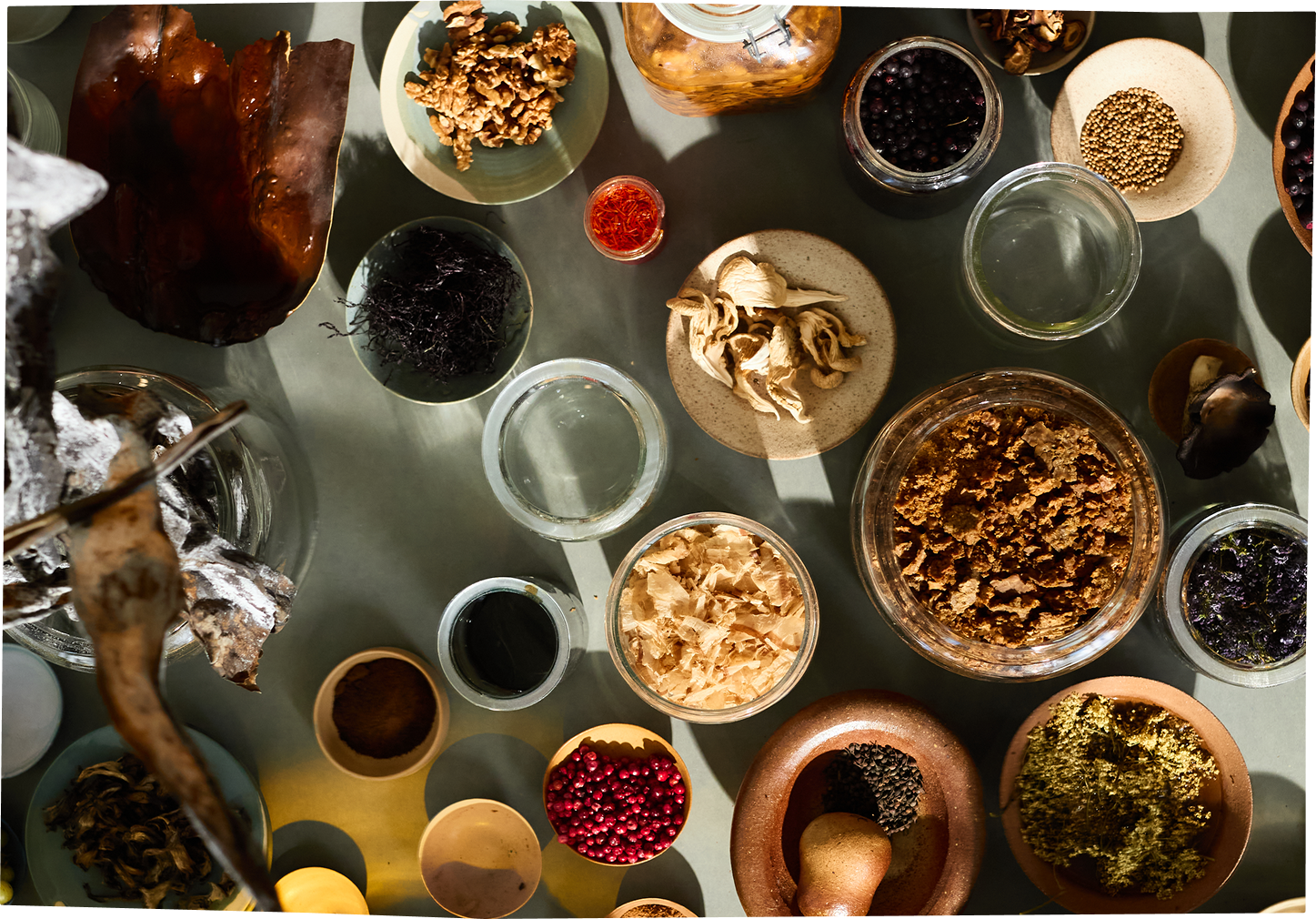
Last week we brought together teams from Belmond Hotels for a series of talks and workshops centered on creativity in the kitchen. Featuring insights on hyper-seasonality and circular cooking processes from Matt Orlando at ESSE, colorful flavor experiences from the R&D labs of Noma Projects and Noma Kaffee, and focused explorations of the Nordic Food Manifesto as a catalyst for cultural revolution. At its core, creativity not only means thinking expansively, but also placing the necessary restrictions to make a change in both a sustainable and interconnected way.