

Looking Inward
A conversation with Aviâja Lyberth Hauptmann on Greenland, food sovereignty, and why the plant-based diet we're all pushing may represent "a failure of imagination"
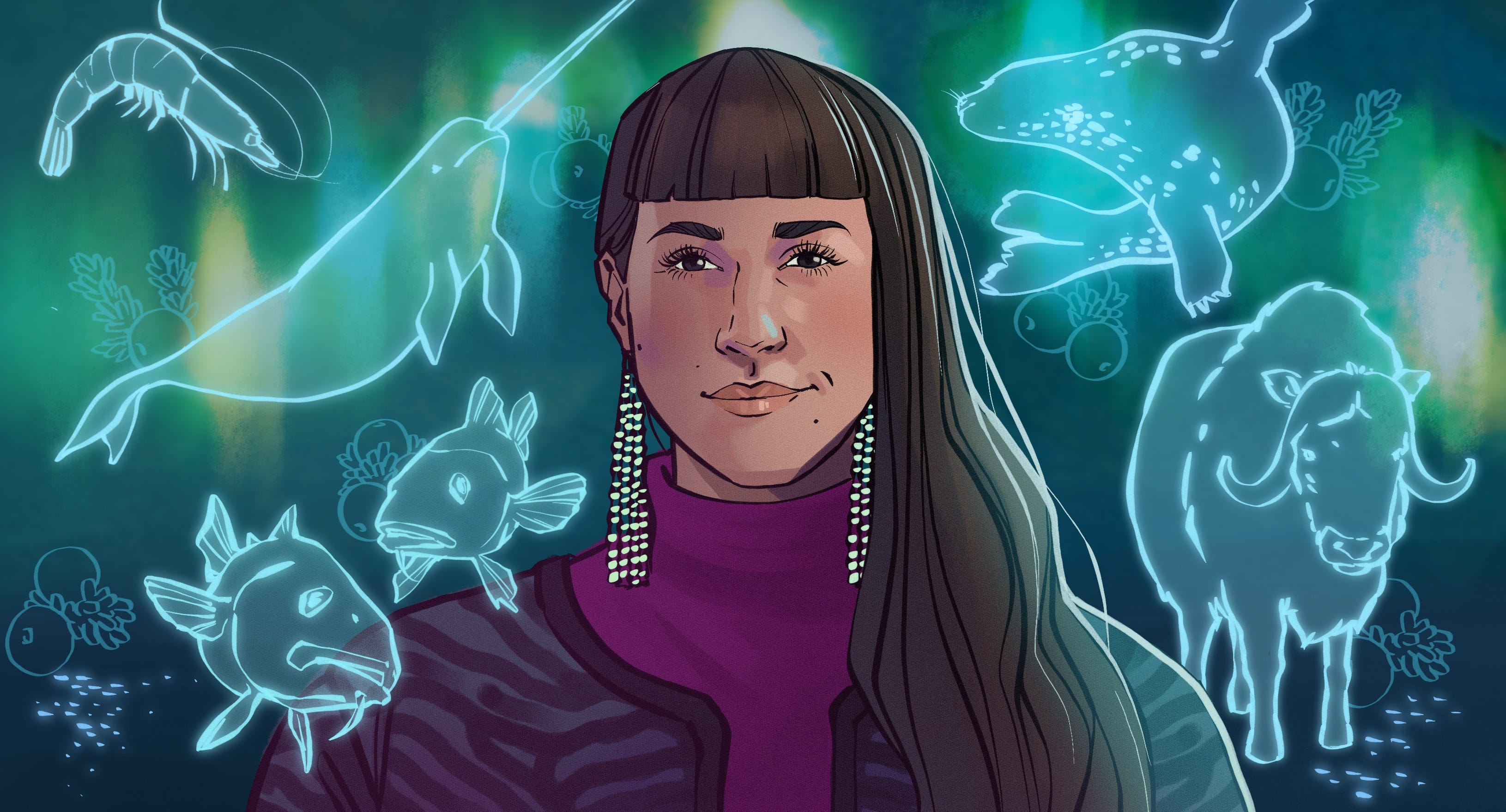
With everything that’s happened in the interval, it’s hard to believe that it’s only been two months or so since those tense weeks when Greenland was the focus of the world’s attention. But if our jacked-up hamster wheel of a news cycle has (temporarily?) pushed rogue imperialism in the Arctic off the front page, the threats to Greenlandic sovereignty have not disappeared. And, as Aviâja Lyberth Hauptmann made clear when we spoke to her recently, that includes threats to food sovereignty.
A microbiologist at the University of Greenland, Aviâja researches the gut microbiome and the Inuit diet. What she’s discovered requires a re-examination of many Western preconceptions about what constitutes a good, healthy, — and sustainable — diet. And it brings a whole new depth to what it means to eat locally.
Born in Nuuk to a Danish father and an Inuit mother, Aviâja grew up near the Arctic circle in the town of Sisimiut before her family moved, when she was 10, to Denmark. Nearly two decades later, and with a newly minted doctoral degree in microbial metagenomics under her belt, she returned to Nuuk, where she works at the University of Greenland, researching the microbes in traditional Greenlandic foods and the gut microbiome of the people who eat them..
Her work grew out of an absence. When Aviâja was starting her academic career, the gut microbiome–the ecosystem of microbes that lives in our digestive systems–was a hot topic in biology circles. But it quickly became obvious to her that something important was being left out of the research. “I was surrounded by scientists working with the gut microbiome of human beings,” she says. “And it was just very obvious to me that the food culture that I come from was not represented in that work.”
The traditional Inuit diet is based almost entirely around wild animals: sea mammals like walrus, seal, and whale, as well as caribou, musk ox, fish, and seabirds. Plants like berries, roots, grasses, and seaweed round things out but are markedly less central than animal foods. These days, the modern Danish diet has made serious inroads into indigenous ways of eating, and along with chips, cookies, processed meats and frozen pizza (and their accompanying rates of diabetes), Nuuk’s supermarkets are well-stocked with imported strawberries and pineapples. Even so, many Greenlanders continue to hunt and eat traditional foods. The fact that those foods weren’t represented in scientific discourse, she says, “has a lot to do with the limitations of our imagination.”
That limited imagination has resulted in narratives about nutritional needs that can fail the humans they’re aimed at. Vitamin C is a case in point. Most of us have assimilated the message that the best source for this important nutrient is citrus. “But we forget that very few populations had citrus fruits during most of their evolution,” Aviâja says. “And it’s also not the reality for a lot of people today.”
The fact that the Inuit have managed for centuries not to die of scurvy despite the stubborn lack of orange groves on the inland ice, suggests that citrus isn’t the only possible source of Vitamin C. There is, for example, mattak, a prized Greenlandic food. “It’s the skin of narwhal and beluga whales and it’s high in Vitamin C,” Aviâja says. “And the organs of the same animals have really extremely high amounts–higher than citrus fruits.”
A message that privileges supermarket oranges imported from thousands of miles away over mattak is not only bad for the environment; it also erodes local self-sufficiency, making Greenlanders dependent on international conglomerates and global supply chains for their food, and undermining a local food culture that has come up with its own perfectly good source for the nutrient.
It can also have health implications. Thanks to nutritional guidelines imported wholesale from Denmark, children in Greenland are officially advised to drink half a liter of milk a day. And yet, as Aviâja points out with the controlled patience of someone who can’t believe she still has to explain this stuff, Inuit are lactose intolerant. “We have the numbers,” she says. “We have data that shows that Inuit do not cope with calcium the same way as Northern Europeans do, and that it can be harmful to have it in the same amounts. But still, we do this thing.”
That ‘thing’–treating nutritional needs as universal–is perhaps most evident in the big policy initiatives that many of us have internalized as accepted wisdom. And when it comes to food, there is perhaps no clearer example of it than the promotion of plant-based diets. Which is why Aviâja reserves some of her sharpest criticism for efforts like that of the EAT-Lancet Commission, which explicitly claims its “planetary diet” is adaptable for all cultures worldwide.
“A great solution for the whole planet,” she suggests drily, “Is probably a terrible solution for most of it.”
As a scientist, Aviâja knows that, in some contexts, a plant-based diet can improve health and environment outcomes. But some contexts are not all contexts, and equating your own group’s situation with that of every other group on the face of the earth can look suspiciously like a form of cultural imperialism. “It’s so far from an Arctic indigenous diet,” she says of EAT-Lancet’s plant-based recommendations. “And I think it’s harmful in the sense that it completely misses what food is to us, beyond just something that makes us full and helps us build cells in our bodies.”
For the Inuit, Aviâja argues, food is place, a way of knowing a coastline, or a particular stretch of ice. “Food for us as indigenous peoples is our relationship to the place that we call home — not just the nation or the country, but very locally. This particular fjord, I have a relationship with because me and my family, we hunt there.”
The global food system supplants that kind of knowledge and connection with the seductive appearance of ease and abundance, and resisting its pull may mean making hard choices. “Maybe papayas and pineapples and strawberries just do not have a place in an Arctic supermarket,” she says. “Putting it very harshly: strawberries aren’t a human right.”
Real food sovereignty, in other words, expands the notion of eating locally beyond mere geography to consider culture and identity. Which is why, when asked if she thinks the Greenlandic example has lessons for other peoples, Aviâja demurs. “I would never do that — push my solutions somewhere else,” she says. “That is up to each and every single place to figure out on their own: who they are, what aligns with their current situation, with their ancestry, with the land that they’re on.”
But she does offer a hint to figuring it out: qarrtsilluni. The Inuk word refers, she explains, to “a way to listen to what comes from within,” and it acts as a check on our tendency to always be looking toward what others are doing. “A major part of qarrtsilluni is to be in silence, not listening to the trends, not seeing all the information that is out there in the world, not trying to learn new things, even for a while, to just sit and feel what comes up from inside,” Aviâja says. “There’s a whole world out there, but there’s a whole world inside ourselves too.” The trick is to balance the two.
What speaks to Aviâja from inside is how deeply tied identity is to food sovereignty. When the US was actively threatening to take over her country back in January, she found herself in tears as she imagined what it would mean to be displaced from Greenland. “It really made it so clear to me how fortunate we are to be living on our own land, where our ancestors have been for hundreds of years,” she says. “Land that, through food, we have a connection to.”

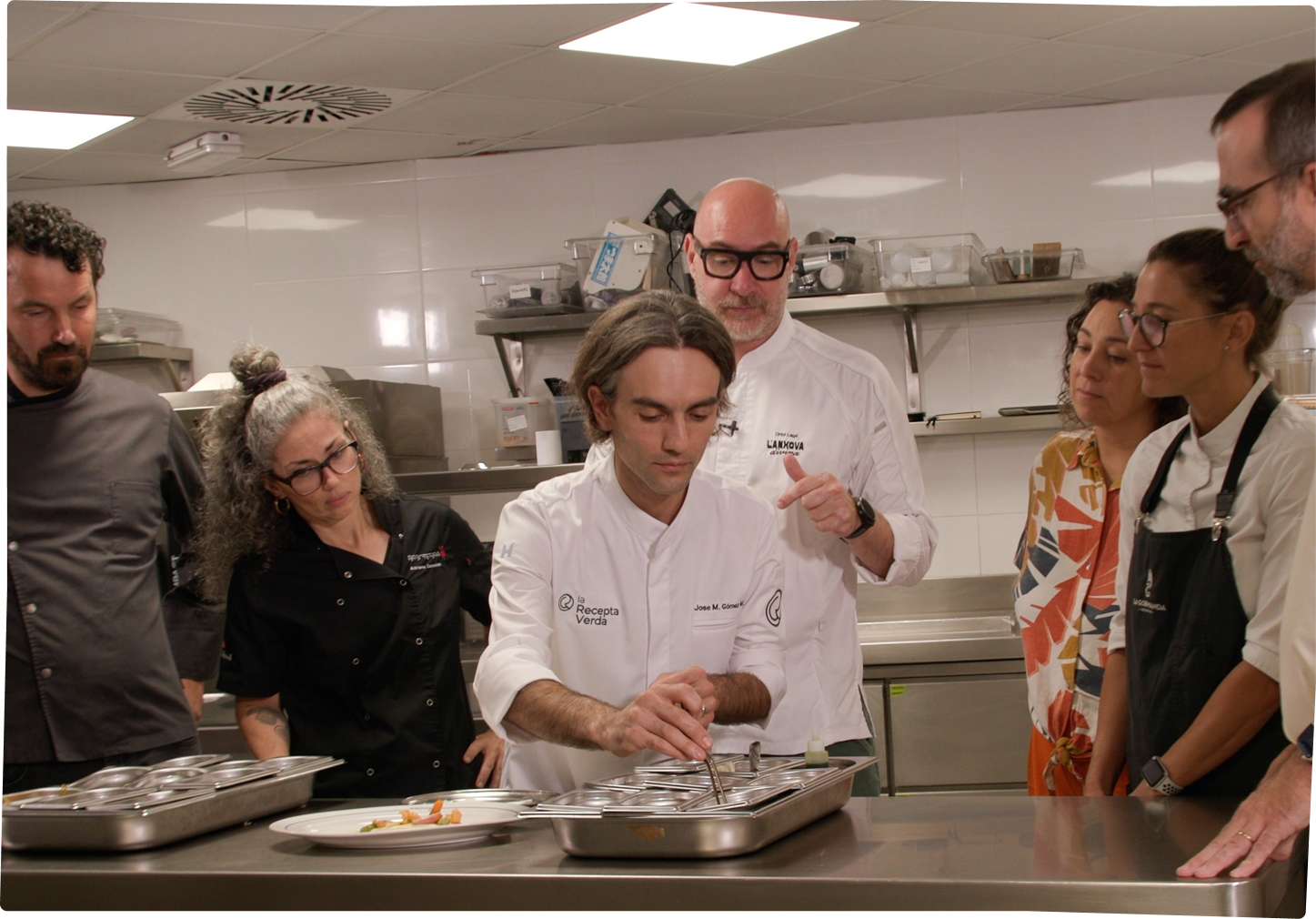
La Recepta Verda (Rethinking Origin) | Jose Miguel Gómez Morales
The traditional recipe tells you how to cook a dish. It has never told you what to do with what's left over.
Working at El Celler de Can Roca has been the highlight of my culinary path. The intensity of daily service, the discipline of hard work, and the shared commitment of people from all around the world, each focused on the same goal, was almost impossible to put into words. There was a sense of collective purpose and excellence that felt close to perfect.
As with everything in my life that has felt close to perfect, I eventually noticed a quiet contradiction. Within this environment, built on deep respect for ingredients and craft, much of the food being discarded was not the result of neglect or poor quality, but of routine. Perfectly usable ingredients simply had no defined place once the recipe was complete.
As I looked more closely, I realised that the problem was not a lack of care, but a lack of instruction. Recipes, the very tools we rely on as cooks, tell us what to prepare and how to execute a dish, yet remain silent about what happens to trimmings, surplus preparations, and leftovers generated along the way. We work with precision and intention, yet what falls outside the recipe falls outside responsibility.

The Vilcek Foundation is now accepting applications for the Vilcek Prizes for Creative Promise in the Arts—this cycle with a focus on culinary arts, including food, beverage, and culinary storytelling. It’s a great opportunity for early-career immigrant chefs, food creatives, and culinary professionals who are shaping culture through their work. Each award includes an unrestricted $50,000 prize plus increased visibility through a professional PR campaign. If you were born outside the U.S. (to non-U.S. citizen parents), are 38 or younger, and have at least five years of professional experience, you’re encouraged to apply. Deadline: May 4, 2026.

The display banner should reflect the reality it is trying to critique, with imagery of violence and dead animals surrounding Aviâja, rather than showcasing serene, thriving blue-toned beings. If the goal is to provoke thought, the visual language needs to align with that message.
The idea behind plant-based diets was never about importing avocados from Peru or following a Western narrative. At its core, it is about exploring how we can nourish ourselves while minimizing harm to other living beings.
It is worth questioning why we feel entitled to take lives simply to meet nutritional needs, when alternatives exist. Perhaps it is time to pause, reflect on these deeply ingrained instincts, and move toward a more compassionate and conscious way of living, where we do not take other creatures’ lives for granted or reduce them to sources of nutrients like vitamin C or B12.