

The Zero Waste Communication Conundrum
Some forward thinkers convene to talk about how they talk

You might not expect a fine-dining chef like Matt Orlando to get ideas from 7-Eleven.
And yet, as the chef behind Copenhagen’s newly opened Esse, (and Amass before that), recently told a symposium on upcycling at the city’s Hotel and Restaurant School, that’s exactly what happened. After the Scandinavian division of the convenience store chain purchased a large quantity of a chocolate alternative, called THIC, that Matt and his team had developed, to replace the chocolate in their chip cookies, Matt asked the 7-Eleven bosses how they would market the new product. Their reply came as a shock. ‘They said, ‘We’re not,” Matt told the audience. ‘We’re going to replace the chocolate and not tell anyone.”
Once he got over his surprise (at 7-Eleven, they now refer to the sweets flecked with chunks of THIC simply as ‘Light’ or ‘Dark’ Cookies), Matt started wondering if there wasn’t a lesson there for him. At his previous restaurant, Amass, tableside discussions of the ingredients, techniques and processes that went into reducing the kitchen’s environmental footprint constituted a core part of the place’s identity and its guests’ experience. But Amass had closed in 2023, and as he opened Esse, Matt was re-evaluating that approach. “One of the things I came to understand,” he said, “Is that we need to figure out a new way to talk about these things.”
He’s not alone in that thinking. Gathered on stage with him at the November symposium to discuss their own approaches to running environmentally responsible restaurants were some of the most innovative folks working in the arena: Lara Espirito Santo and George McLeod of Lisbon’s Sem; Albert Franch Sunyer of Helsinki’s Nolla; Christoffer Norton and Ben Hurley of Aarhus’ Domestic, and Ryan Walker, from London’s Silo, whose founder, chef (and MAD Academy resident faculty) Doug McMaster pioneered the notion of “a restaurant without a bin.” And all of them agreed: communication was one of the trickiest parts of what they were trying to pull off.
The vocabulary alone can be confusing. Consider the sheer number of words available to describe the approach: Recycled. Zero Waste. Upcycled. Regenerative. Circular.
In many ways, the issue of which word(s) to use in zero waste restaurants mirrors that of sustainability in general. After all, terms like ‘sustainable’ and ‘green’ carry a huge range of nuance and interpretation–to say nothing of questions. (Are you sustainable if you source locally but your guests fly in from all over the world? Can you call yourself ‘green’ if your ingredients are organic but you serve meat? Etc. Etc. Etc).
But the words have also become so overused, and— as anyone who has ever watched as, say, McDonald’s attempts to position itself as climate friendly—appropriated as to be virtually meaningless. At Nolla, Albert says, “We don’t even use the word ‘sustainability’ because the big terms tend to be used by people or groups that you don’t want to associate yourself with.”
Sem doesn’t use the word either. Instead, Lara says, they focus on outcomes like responsibility and impact. And they define very clear goals where “we talk about supporting regenerative agriculture and fighting food waste. Those are the main objectives that guide every decision that we make.”
Beyond the relative value of the words, there’s also diner preference to consider, since it turns out that not everyone wants a lesson on environmental stewardship when they go out to eat. “You want to create an environment where you feel welcome, you feel comfortable,” said Ryan in his talk at the symposium. “Not a restaurant that is trying to shove the idea of sustainability down your throat.”
Yet all of those challenges are compounded when the notion of reducing waste (Or byproducts. Or trim. Or discard. You get the point) is introduced into the equation. The word, after all, “is a pejorative, with negative connotations,” says Lara. “We still get guests who ask, ‘But what do you do with the leftover food on people’s plates?’ Because that’s what they think waste is: something designated for the bin.”
The chefs and founders who joined the Upcycling Symposium have a more sophisticated understanding. With their cooking, all of them strive to use the parts of vegetables and other ingredients that many kitchens discard–and not just incorporate them, but enhance them explicitly for what they bring to a dish. That might mean, as Matt does, incorporating the shells of fava beans into a tart crust for the distinctive flavor–distinctive from the beans themselves–they add, or using fermentation to create, as George does, a tomato amino from the previous year’s seeds that can add punch in the dead of winter. “The constant objective is to create intrinsic value from things that it’s much easier to throw away,” Lara explains.
But ingredients are just the start of it. At Silo, the restaurant itself is built from upcycled products: countertops from used plastics, floors from used cork–an inspiration that Esse followed when it commissioned artist Thomas Dambo to craft its striking chandeliers from upcycled wood.
At Domestic, they’ve dramatically reduced their paper use, and are aiming to eradicate it altogether in the coming year. At Nolla, empty wine bottles are cut and polished into glassware, produce is delivered in reusable crates, and they’ve even managed to reduce the chemicals they use by investing in a machine that ozonates regular water, imbuing it with disinfectant and antimicrobial properties so that they can do away with synthetic cleaning supplies.
These are just examples; what stands out most about each of these places is the holistic approach they take to the entire ecosystem of a restaurant, not just the food on the plate. Yet for all their common purpose, each of the them takes a slightly different approach to actually communicating about what they’re doing.
At one end of the spectrum was a restaurant like Amass, which was, as Matt explains, “very aggressive about how we talked about these things, and really focused on that vocabulary of stems and skins and seeds.” At the other, is Nolla, which doesn’t really talk about its initiatives at all, preferring instead to ensure that, from the guest’s experience, dinner is just like at any other “regular” restaurant. “From the very beginning, we believed that if we didn’t normalize what we do, it would stay something strange, weird, basically artificial,” Albert says. “That it would only be a concept. And not what we wanted it to be, which is a real model. For it to be normal.”
In the dining room, Sem is similarly reticent. “Most people come because someone told them this was a great restaurant, and at the end of the day, that’s what we have to do: we’re a restaurant, people have to come because it’s good,” Lara says. “If we can get some information across it’s awesome, but that’s not the objective.”
Still, there’s a clue for those who want to know more. On Sem’s menu, each item bears a tiny number, like the ones in casual restaurants that identify allergens. Only instead of flagging lactose or crustaceans, these correspond to the dish’s positive impacts: upcycled ingredients, an invasive species, a regenerative method of growing. Importantly, this “impact key” not only gives information to the guests, but to the staff as well. “If people are there just to eat and have a good time, they can look at it, and that’s it,” Lara says. “But if someone’s like, ‘oh, this is really cool or ‘what do you mean by this?’ then it’s a conversation opener for the guests without being in their face.”
Along with communicating openly about their zero waste practices in their social media, creating that kind of hint or invitation in the dining room without being overbearing, is also a common strategy. Everything from unusual looking cutlery to, well, a composter in the middle of a room (Nolla) can function as a trigger, piquing the curiosity of a guest to ask a question, and inviting the staff to go deeper.
But even then, it can be tricky to calibrate. How do you judge how much information a guest wants? How do you train your staff to respond sensitively? These are questions that, as he launches Esse, Matt is considering anew. He knows that he wants the conversation around their objectives to be more refined than it was at Amass, and to that end, he is moving toward a more holistic view of how they discuss the raw materials with their guests. “Before, I think we didn’t know how to talk about in a way that was respectful towards the ingredients without referring to stems and skins and seeds. But if you make a smoked oil from the flesh of a tomato, you don’t call it a smoked tomato flesh oil–it’s just a smoked tomato oil. So if we make it from the skins, why should we say that? It stigmatizes the ingredients out of the gate.”
And, like the others, he and his staff are making a point of taking their cues from the guests. Although each table is greeted with what he calls an ‘opening spiel’ that provides some context they otherwise forego the process-oriented explanations with each dish unless explicitly asked. (Having a dish of noodles made from fishbones usually does the trick.)
All of the chefs left the Upcycling Symposium excited by their exchange, and by the sense–still fledgling but enthusiastically greeted by the students in the audience– that their approaches were cohering into something like a movement. But they also recognize that they haven’t figured out all the answers when it comes to communication.
As if to prove the point, a week after the event, one critic at a Danish newspaper faulted Esse for not explaining enough. “So it’s still very much a work in progress,” says Matt.
Still, there are encouraging signs. On one recent night, the girlfriend of someone on the Esse team came in to eat at the bar. She had never been to Amass, and when she walked into the new place she had no idea what it was trying to accomplish. But at home that night, “she told her boyfriend ‘I left the restaurant and I wanted to do something; maybe I could start by taking a shorter shower,’” Matt recounts. “That’s exactly the kind of reaction that you want: for someone to leave your restaurant and ask, ‘what can I do?’”
What about you? How do you communicate about zero waste and other initiatives in your restaurant—or do you? Share your ideas in the comments!

WHAT WE’VE BEEN UP TO
MAD Monday LA
Last month we hosted a MAD Monday in LA. We gathered our West Coast friends for a conversation about borders, exploring the richness that movement (of people, ingredients, ideas) adds to our industry. It was the first of a series of events we’ll be continuing in the spring…
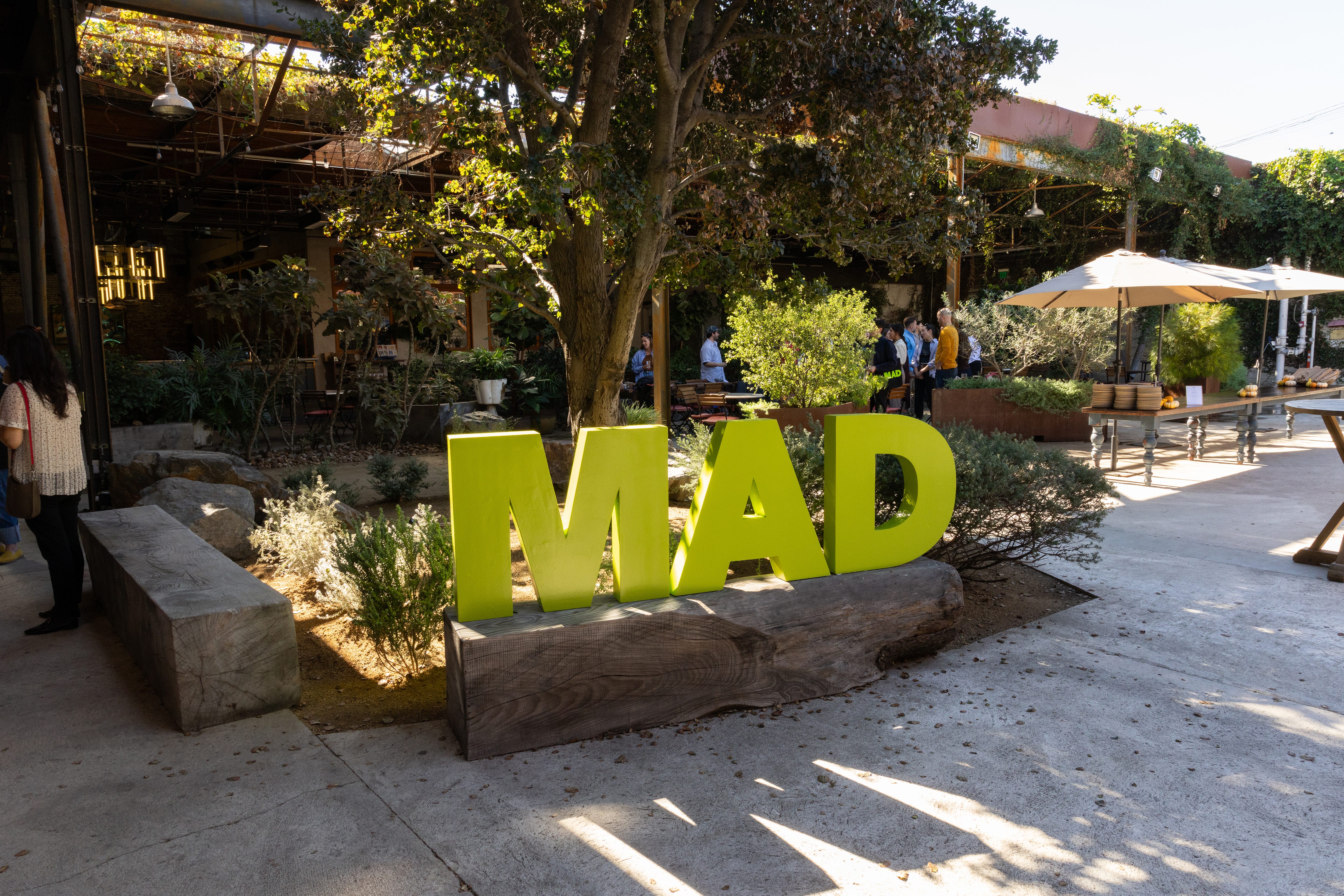
Coming Soon: MAD LA 2026
And so the news is out: MAD is coming back to Los Angeles in 2026!
Stay tuned ☀️

Brilliant article. Something we are talking about a lot in Australia too... Thank you for doing it!!!
So how is the US going to accomplish change?